MCP MongoDB Server



A Model Context Protocol (MCP) server that lets AI assistants work with your MongoDB databases. It exposes your collections, infers their schemas, and runs queries, aggregations, and writes through a standard interface — so tools like Claude Desktop and Cursor can read and reason about your data.
Demo
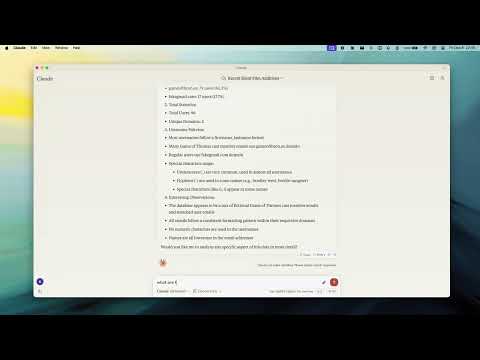
Why use it
- Talk to your database in plain language — the assistant discovers your collections and their shape automatically.
- Safe by default — turn on read-only mode to let an assistant explore without any risk of changing data.
- Works everywhere — connects to standalone, replica set, sharded, and Atlas deployments, over plain or TLS connections.
Key Features
- Read-Only Mode — blocks every write path (insert, update, index creation, and aggregation stages like
$out/$merge that could modify data).
- Smart ObjectId Handling — configurable
auto/none/force conversion of 24-character hex strings to ObjectIds.
- Schema Inference — automatic collection schema detection from document samples.
- Query & Aggregation — full query and aggregation pipeline support, with optional
explain plans.
- Write Operations — insert, update, and index creation (when read-only mode is off).
- Time Conversion — a
convertTime helper turns Unix timestamps and date strings into UTC/GMT/ISO, so date queries stay unambiguous across timezones.
- Progress & Cancellation — long operations report progress and can be cancelled mid-flight.
- Two Transports — run locally over stdio, or expose an HTTP endpoint for remote access.
Requirements
Quick Start
Point the server at your database — no install step needed:
npx -y mcp-mongo-server mongodb://localhost:27017/mydatabase
Explore safely, without any chance of changing data:
npx -y mcp-mongo-server mongodb://localhost:27017/mydatabase --read-only
Usage
Local (stdio)
This is the default, used by Claude Desktop, Cursor, and other local clients:
npx -y mcp-mongo-server "mongodb://user:pass@localhost:27017/mydatabase"
Remote (HTTP)
Expose an HTTP endpoint at /mcp for remote or multi-client access:
npx -y mcp-mongo-server "mongodb://user:pass@localhost:27017/mydatabase" --transport http --port 3001
By default, only requests without a browser Origin (CLIs, IDEs) and requests
from localhost are accepted; everything else is rejected with 403 to guard
against DNS-rebinding attacks. Allow specific browser origins with
--allowed-origins:
npx -y mcp-mongo-server "mongodb://..." --transport http --port 3001 --allowed-origins "https://app.example.com"
Options
Environment Variables
Security
Database scope. The server operates on the database in your connection
string. Aggregation stages that reach another database ($out, $merge,
$lookup with an explicit db) are rejected by default, so a pipeline can't
quietly read from or write to databases you didn't point it at. Enable them
with --allow-cross-db if you need them.
Server-side JavaScript. The aggregation operators $function, $where,
and $accumulator run arbitrary JavaScript on the MongoDB server. They are
rejected by default; enable them with --allow-server-js if you trust the
pipelines being run.
Read-only mode blocks every write path, including aggregation stages that
write or run server-side JavaScript ($out, $merge, $function, $where,
$accumulator).
Least privilege. Application-level checks only go so far — the strongest
guarantee comes from the database. Connect with a MongoDB user scoped to just
the database you need, with read-only permissions when the assistant only needs
to explore. That way the database itself enforces the boundary, as defense in
depth.
Documentation
License
MIT — see LICENSE for details.